23 May 2011

Marketing Mix: Product / Service Guide #5

Don’t separate your product names from your brand name.

The most powerful asset that marketing people are given by their company to perform their marketing job is the brand name.  In exchange for the use of this asset, marketing people have the responsibility to nurture their brand name.  Don’t revert to short hand when communicating about your products.  Each time the product name is used in copy, ensure that it is preceded by the brand name.  While this practice would seem to be redundant in body copy, your target customer learns through repetition.  Each repetition of your brand name builds the brand in the memories of your target customers.  Each repetition of the two words, links the product name to the brand name.  Whatever equity attributes are associated with your brand name are linked to your product.
In essence, this guide leads you to treating every product as a brand extension.  But isn’t that exactly what you want?  You want every product to be an extension of your brand.  I know that some popular marketing authors decry the over-use of brand extensions arguing that they dilute a brand, and they argue that the marketer should be creating new brands rather than relying upon brand extensions.  On one side of the coin, they have a legitimate point; generally speaking, the narrowly positioned brands tend to be stronger than those that have a more general positioning.  However, I would argue the opposite side of the coin:  building new brands is expensive and most marketers don’t have the resources to build and sustain a large number of brands.  If you de-link your product name from your brand name, you’re treating that product as a stand alone brand; and you better be prepared to have the resources to support that new brand.
Learn from Other Marketers’ Mistakes:  I’ve mentioned in this blog that Acura moved from product names that have meaning to alphanumeric product names because they had created so much equity for the Legend product name that the Acura brand name suffered.  Acura was taking advantage of the marketing guide that consumers tend not to remember alphanumeric names.  By using product names such as RL, TL, etc., Acura encouraged consumers to, more often than not, place the brand name in front of the product name when discussing their vehicles, Acura RL, Acura TL, etc. to ensure that they were understood.
Learn from My Mistakes:  I often tell people that in my 40-year marketing career, I have made every mistake that one can make in marketing.  In the early 1980’s, I was working for the tire division of The BFGoodrich Company.  At that time, the company was investing in its divisions that were in growth product categories and starving the mature tire division of resources.  While this approach to investment was entirely consistent with increasing shareholder value, the management of the tire division felt like abandoned children waiting for the company to harvest the division (which eventually occurred).  With no competitive advantage other than marketing, the tire division had survived competing in the category because of its line of high margin performance tires called T/A Radials.  Tire division management made the decision to use the product name T/A Radials de-linked from the brand name BFGoodrich.  For a long period of time, the marketing efforts of the firm centered on T/A Radials and minimized the brand name BFGoodrich. The result was that among the brand’s target customers, T/A Radials became more remembered than the brand, BFGoodrich.  Since other product lines were being marketed under the BFGoodrich brand, those product lines suffered with the decline in equity for BFGoodrich brand.

18 May 2011

Marketing Mix: Product / Service Guide #4


For a marketer with a multi-brand portfolio, keep your brands separate from one another.

Follow the Proctor & Gamble approach; keep your brand separate from one another. In just the laundry category alone, P&G markets six brands of laundry detergent in the U.S.: Bold, Cheer, Dreft, Era, Gain, and – the category leader -- Tide.  Each of these brands has its own unique positioning and is not tied to the parent company.  This allows P&G to create different values for different segments of the market.

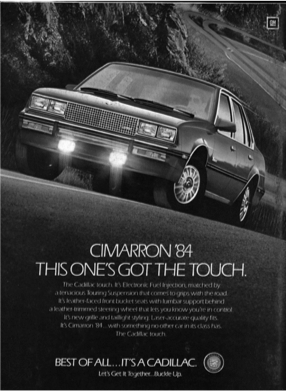
A classic example of ignoring this guide is the old General Motors.  Among the many problems that the old GM created for itself, its “badge engineering” diminished the difference between their brands.  Why should someone buy a Buick when they can get the same car with minor trim differences at a lower price from their Chevrolet dealer?  Badge engineering at GM reached levels of absurdity in the early 1980’s when all five divisions of GM attempted to market their J body car.  The same basic car was marketed as the:
            Chevrolet Cavalier
            Pontiac Sunbird
            Oldsmobile Firenza
            Buick Skylark
            Cadillac Cimarron
In addition to products that were mostly the same from brand to brand, the old GM loved corporate advertising in which the lumped together their brands with tag – Chevrolet, Pontiac, Oldsmobile, Buick, and Cadillac.  Is it any surprise that the old GM brands ended up with not much to distinguish one brand from another?  One brand cannibalized another because they were appealing to the same kind of customer.  This led to the demise of the Pontiac and Oldsmobile brands.  Hopefully, the new GM will do a better job of keeping their remaining brands separate from one another.
In product categories where consumers can’t tell the difference in brands by looking at the physical product, it’s vitally important to keep the brands separate.  If customers can’t tell the quality difference in brands by looking at the physical product (which is the case in many, if not most, product categories), they will default to the low-priced brand thinking that all of the brands are the same.  Most package goods categories (fast moving consumer goods, for the Brits) are examples of product categories where consumers can’t tell the quality difference in brands by looking at the physical product.  I’ve made my living in brand marketing; I believe that brands deliver value to their target customers; and I usually buy brands (especially clients’ brands).  However, in some product categories I can’t tell the difference between branded products and private label products, and the price difference is so great that I default to the private label product.  Club soda is an example.  The branded products, Canada Dry and Schweppes, retail for over $1 for a one liter bottle; the store’s private brand usually retail for one, two, or three bottles for something over the same $1.  Do the branded club sodas have value for me?  Yes.  Is there sufficient value for me to justify paying a price 100% or 200% or 300% higher than the store brand?  No.
Most marketers offer their various brands at different price points even if the costs associated with making and marketing each brand are roughly the same. Some customers in some market segments are willing to pay more to obtain the value of the brand.  Those brands for which consumers are paying more generally create a higher profit margin for the marketer.  If customers became aware that a lower priced brand was made by the same company that made their preferred, higher-priced brand, they would look at the lower-priced brand, look at higher-priced brand, and probably buy the lower-priced alternative because the physical products look about the same to them.  The marketer would end up trading high margin business for low margin business.


09 May 2011

Marketing Mix: Product / Service Guide #3

Technology and innovation are neither product nor brand benefits.

Note:  This guide could have been contained in the list of guides on brand positioning or in the upcoming group of guides on marketing communications or in the product / service portion of this blog.  For no particular reason, I’ve elected to include it in the product / service section.

In my work with the Kotler Marketing Group, I’ve consulted to a few companies in “high tech” product categories.  Whenever I mention this marketing guide, there is an audible gasp in the room.  This is a marketing guide that many companies, especially those companies in high technology product categories, violate regularly.  Such companies are proud to see themselves as innovators.  They may even have incorporated their pursuit of innovation in a corporate mission statement, and the quest for technological innovation may be deeply rooted in their corporate culture. 
That may be who these companies are, but don’t believe that’s why people buy their brands.  People buy their brands to get the brands’ unique brand benefit that fulfills their want/need.  Remember from this blog’s discussion of brand positioning that the unique brand benefit in consumer goods categories satisfies some internal want/need within the consumer, and in business-to-business categories the unique brand benefit satisfies the economic needs of the business.
It is true that some product categories have small market niches composed of customers who want the latest technology; for example, there are audiophiles, computer geeks, and automotive enthusiasts.  The benefit that these consumers are seeking is probably some type of ego gratification from having the latest technology available. 
Early in my marketing career in the tire category, my co-workers spoke about the “enthusiast” in the performance tire category.  They would say that the enthusiast was more receptive to marketing communications messaging for performance tires because they were interested in tires.  Later in my career, I was sitting in a meeting at Grey Advertising in New York, and the Creative Director on the account said, “There’s no such thing as a tire enthusiast; or if there is, they work for tire companies.  The enthusiasts that are so often referenced in your thinking are not tire enthusiasts, they are automotive enthusiasts.”  The lesson here is that if there is an enthusiast segment within your product category, be sure that the members of that segment are enthusiasts of your product category and not some allied product category.
So what is the role of technology in your marketing efforts?  Some technologies and technical features may serve as benefit supports.  Returning to the tire category as an example, in the business-to-business truck tire category, Michelin has the technology to produce a single tire that will carry the load formerly carried by dual tires.  The weight of this tire and its wheel is less than the weight of two tires and two wheels.  This means that in some trucking applications such as bulk hauling, the operator will be able to carry more cargo.  By carrying more cargo, the operator will increase revenue which speaks directly to the economic motivation of business- to-business customers.

02 May 2011

Marketing Mix: Product / Service Guide #2

Marketing Mix: Product / Service Guide #2 -- Customers tend not to remember alpha numeric names.

It’s true that people tend not to remember alpha numeric names.  However, if this guide is true, why do so many companies use abbreviations as their company brand names?  One reason is that end-users, especially Americans, prefer to short-hand their speech.  Generally, people will short-hand names to reduce the number of syllables.  The nine syllable International Business Machines became the three syllable IBM. 

The five syllable Federal Express became the two syllable FedEx.  If the short-handed name has the same meaning to target consumers as the full name, then there’s no danger in a company adopting the short-hand name.  However, if the short-hand name has no meaning to current and/or future target customers and the long-hand name did have meaning, then there’s a risk.

Another example of people short-handing brand names is a brand that I worked on for many years, BFGoodrich Tires.  Those familiar with the brand often refer to it as BFG.  (Three syllables instead of four).  However, the majority of the brand’s target customers don’t have this degree of familiarity with the brand and don’t use the BFG short-hand.  Survey research showed that among target customers there was substantially less association of BFG with being a tire brand than there was with BFGoodrich.
Another reason that short-hand company names have become more popular is to obfuscate the company’s origins.  The worldwide financial services giant, HSBC, wants its target customers to think of it as “The world’s local bank,” not as a bank with locations in Hong Kong and Shanghai (Hong Kong and Shanghai Banking Corporation). 

DHL wants its target consumer to think of it as “proven reliability” not as a business founded by Adrian Dalsey, Larry Hillblom and Robert Lynn.


It’s interesting that most of the major American advertising agencies violate this guide. For example, the three major agencies making up the Omnicom Group agency holding company are BBDO, DDB, and TBWA. Each of these three agencies are rich in history and have names that are the initials of their founders. DDB was formerly Doyle Dane Bernbach which was named after the three founders of the agency, Ned Doyle, Mac Dane, and Bill Bernbach. Bill Bernback was the creative lead of the agency and the person responsible for transforming advertising from Rosser Reeves-style repetitive hard-sell approach to a soft-sell approach using wit and humor. Examples of this work are the Volkswagen "Think Small" campaign and Avis "We work harder because we're number 2." All of this great history is a brand asset for DDB. However, it's lost in the reduction of Bill Bernbach's name to the letter B in DDB. In my opinion, advertising agencies' use of meaningless letter names reflects that most advertising agencies are specialists in marketing communications rather than marketing generalists. No offense to my many good friends in the agency business, but there is more to marketing than just marketing communications.
If you find yourself in the position of your product names being more memorable than your brand name, then you can use this guide to your advantage.  Acura, the upscale Honda brand in the U.S., found that its products, the Legend and the Integra were remembered by more of its target customers than the Acura name itself.  To get its target consumers to focus more on the Acura brand and less on the model names, Acura switched to an alphabetic model designation – the RL, TL, TSX, etc.  

25 April 2011

Marketing Mix: Product / Service Guide #1

Product / Service Guide #1 -- Good names are suggestive of benefit or use.

What do you do with Kleenex tissue?  You clean your nose.  What do you put on your cut finger?  A Band-Aid (which is a clever contraction of bandage and first aid.) What does Ultra-Brite toothpaste give you?  Bright, white teeth.  What will you be able to do if you use Close-Up toothpaste?  Get close to the people you want to get close to.  And what does the Close-Up package show?  Two people getting close-up to one another.  

Think about the disposable diaper category.  Mothers want to take good care of their infant children, and the brands in this category deliver that care: Want to demonstrate your love for your baby?  Buy Luvs.  Want to take extra good care of your baby?  Buy Pampers.  Want hold your baby closely?  Buy Huggies.

This guide doesn’t mean that a brand won’t be a success if its name doesn’t suggest benefit or use.  Throw enough marketing dollars at almost any name and you can get your target customers to remember the name and associate some use or benefit with that name.  Rather, this rule speaks to marketing efficiency.  It will take fewer marketing dollars for your target customers to remember a name that suggests use or benefit than one that doesn’t.

Many marketers inherit their brand and product names so they can’t follow this guide.  However, if you’re creating a new brand or new product name, follow this guide.

19 April 2011

Positioning Guide #21

Don’t try to change the customer’s mind.

In the consumer tire product category in the U.S., Michelin brand owns the brand benefit of security.  This is truly remarkable in light of the fact that the U.S. Federal Trade Commission has a regulation that prevents tire marketers from making any safety claim.  This ownership is attributed to the historical quality of Michelin products and almost 20 years of the famous Michelin baby tire advertising.  The Michelin baby conveyed the benefit of safety without actually saying the word safety.  Additionally, consumers don’t attribute their safety to their tires on an unaided basis; rather, they attribute it to their vehicle.  However, on an aided basis consumers will readily agree that their safety is also attributable to their tires.  To remind consumers that their tires are a source of safety, Michelin developed the themeline, “Michelin. Because so much is riding on your tires.”  As long as Michelin nurtures this brand benefit with it’s marketing actions, neither Bridgestone nor Goodyear can take it away.  Neither Bridgestone nor Goodyear should attempt to change the customer’s mind.

In sports drink category, Gatorade owns the brand benefit of winning.  As long as Gatorade continues to invest in and nurture its associations with sports and winning athletes, Coke’s Powerade won’t be able to be the brand for winners.  Powerade shouldn’t attempt to change the customer’s mind.

If customers already attribute the benefit to the larger brand, it’s folly to attempt to change what customers already believe.  For example, want something quick for lunch?  Where to go?  McDonald’s.  Why?  McDonald’s owns the brand attribute of speed of service which translates into the customer benefit of convenience.  This is possibly the motivating benefit for a majority of customers in the fast food category.  Burger King or Wendy’s could spend millions of dollars in advertising trying to convince target customers that they are faster than McDonald’s, and they would fail because target customers already believe that they’ll get in and out of McDonald’s quickly. 

11 April 2011

Positioning Guide #20

As long as your customers believe that you have a given brand benefit, they will not believe that you have a different brand benefit.

McDonalds Brand Benefit:  Speed of Service/Convenience

Great tasting food at McDonalds?  Healthy food at McDonalds.  Food like you like it at McDonalds?  Since McDonalds already owns speed of service/convenience, customers won’t give them any of these attributes and benefits.  This is good news for competitors, if they’re willing to accept the resulting smaller market of customers to whom these things are important.

From an outsider’s perspective, McDonalds competitors’ best marketing efforts have been when they distinguished themselves from McDonalds.  If you don’t want catsup on your hamburger, it’ll be a problem at McDonalds.  You’ll order, move to the side and wait … and wait … and wait.  For you, McDonalds has lost its benefit of speed of service/convenience.

Burger King Brand Benefit: Burgers Customized to Your Taste

In the 1970’s Burger King, the number two U.S. hamburger chain, exploited this weakness in McDonalds’ positioning.  The campaign was often lampooned, but nevertheless extremely effective.  The jingle lyrics were “Hold the pickles, hold the lettuce. Special orders don't upset us. All we ask is that you let us serve it your way!”  Burger King became the brand for those consumers who wanted a hamburger that was customized to their taste rather than the standardized McDonalds burger.

Wendy’s Brand Benefit: “Fresh” – or – “Hot n’ Juicy?”

Wendy’s, the number three U.S. hamburger chain, has attempted to distinguish itself from McDonalds with their “Fresh. Never Frozen.” product claims.  In my opinion, the problem with this approach is that it is indirect.  The real product benefit is that fresh meat will produce a hamburger which is “Hot n’ Juicy.”  It’s a safe assumption that hamburger consumers want hot and juicy hamburgers; however, I’m not so sure that hamburger consumers are interested in the healthy connotations of “fresh”.  In my opinion, they have reversed the product benefit and the product benefit support.  To appeal to the hamburger consumer, the claim should read, “Hot n’ Juicy because they’re made from fresh, not frozen, meat,” rather than “Fresh, Never Frozen so that we’ll have Hot n’ Juicy hamburgers.”
Hardee’s Brand Benefit: Gluttony

The number four hamburger chain in the U.S. is Hardee’s which has stores located primarily in the South and Midwest.  While the trend in American eating habits is toward fresher and healthier foods, there must be some segment in the fast food market which isn’t interested in fresher and healthier.  I would assume that this segment is composed primarily of young males whose high metabolism rapidly burn calories and whose elevated hormone levels make them feel that they are going to live forever.  For this target segment, Hardee’s seems to be attempting to position itself as the brand of choice.  Additions to their menu include the Monster Thickburger which consists of two one-third-pound slabs of Angus beef, four strips of bacon, three slices of cheese, and mayonnaise on a buttered sesame seed bun.  With 1,420 calories and 107 grams of fat, the target consumers for this product should have high metabolism and believe that they will live forever.

04 April 2011

Positioning Guide #19

If you aren’t the pioneering brand in a given category, create a new category in which your brand can be the pioneer.
With apologies to Al Ries and/or Jack Trout, this guide stems from their writings.

While it’s not always true that the innovator, or pioneer, is going to be the long term winner in a given product category (see Positioning Guide #16), the pioneering brand with adequate marketing skills is likely to be the long term winner.  Once the pioneering brand with adequate marketing skill becomes the leader, it also becomes the winner and most customers want to be associated with winners.

I’m no expert in the analgesics (pain reliever) category, and someone with experience will probably correct me.  Nevertheless, I’m going to use the category as an example for this positioning guide.  My counting of generations of new products may not follow the category accepted pattern, but that doesn’t matter in illustrating this guide.


Bayer was first with the aspirin tablet.  They created the product category of aspirin tablets in 1914.  At the time of Bayer’s innovation, aspirin (acetylsalicylic acid) had been around for a while, but in powder form rather than tablet form.  Aspirin relieves pain, is an anti-inflammatory, and reduces fever.  I don’t believe that any of the newer pain relievers do all three of these things.  The problem with aspirin powder, however, was that it took some effort to mix the powder with water prior to ingestion.  Admittedly, the effort required to mix powder is minimal; but, nevertheless, it is effort.  A tablet is more convenient.   

At one time Bayer owned the trademark in the U.S. and many other countries, not only on the Bayer name, but also on the Aspirin name.  As a result of World War I, they lost their trademark on the Aspirin name in the U.S., France, and the United Kingdom (the World War I allied countries).  However, Aspirin is still a registered trademark owned by Bayer in most of the rest of the world including Canada in North America.

The aspirin was the product of choice in pain relief, and Bayer was the leader.  However, the aspirin tablet has some negative side effects, such as upsetting the stomach.  The likelihood of stomach irritation is reduced when aspirin is in powered form, and the powder form gets into the blood system faster than the tablet form.  Nevertheless, consumers preferred the convenience of aspirin tablets.  The problem of stomach irritation was addressed by the first non-aspirin pain reliever - acetaminophen.  Tylenol created a new product category -- non-aspirin pain reliever.  Tylenol became the dominant brand in the new category that they created. 

Americans almost always believe that newer is better.  First, you had aspirin.  Next you had non-aspirin pain relievers.  The third generation of pain reliever was ibuprofen.  The pioneer was Advil, and the product category that Advil created was “advanced medicine for pain”.   Americans were given the choice of aspirin  -or-  non-aspirin pain reliever  -or-  the advanced medicine for pain.   Given this choice, Americans embraced the pioneering brand, Advil.

Now, what’s the problem with aspirin, non-aspirin, and the advanced medicine for pain?  You have to take all of them multiple times during the day to sustain the pain relief.  Introducing the fourth generation of pain reliever -- naproxen.  Naproxen is marketed as Aleve by the company which started this story, Bayer.  “Two Aleve provide relief that can last all day.”  “Compare it!  Based on minimum label dosing for 24 hours, you could take eight Extra Strength Tylenol or four Advil to get the same all-day relief as just two Aleve.” So Aleve has created the fourth new product category, the all-day pain reliever.

Pain relievers is an interesting product category for learning about marketing.  It is a mature product category, but one in which innovation occurs frequently.  The brands in this category don’t talk about their technology, however.  They seek to find unique solutions to human needs, and each unique solution creates a new product category in which the pioneering brand can assume leadership.  Ask yourself, how can you apply this guide to your product category?

28 March 2011

Positioning Guide #18

If the number one brand in a category already owns the motivating benefit for the category, don’t challenge it by claiming the same benefit.

The number one brand in a category is the number one brand because it already owns the motivating benefit for a majority of the category’s customers.  Look for a target segment that wants something else, another benefit.  Yes, that segment will be smaller than the majority segment.  Content yourself with a smaller market share; you’ve already lost the battle for the majority segment.
An example of challenging the established number one in a product category:  Why has Coke, with all their marketing expertise and money, been unsuccessful in knocking off Gatorade as the number one brand of sports drink with their PowerAde brand? 
 Because Gatorade owns the motivating benefit in the sports drink category – winning.  Gatorade owns the motivating benefit of winning through years of marketing investment in sports properties.  They have invested to the extent that the brand has become part of American culture with its association with winners.  What happens to the football coach of the winning team?  He gets an ice cooler full of Gatorade dumped over his head at the end of the game.

So if you drink Gatorade, you’re a winner.  Then who drinks PowerAde?  That’s right, losers.  Gatorade not only owns the motivating benefit in the category, its ownership blocks competitors for successfully competing in the category.

21 March 2011

Positioning Guide #17

Two keys to successful brand positioning are simplicity and consistency.
If imitation is the sincerest form of flattery, Al Ries should be feeling very flattered right now as this guide has been lifted from his contributions to marketing.
Simplicity:  Most marketers are too deeply involved in their product category to view it as naively and simplistically as does their target consumer.  When thinking about the promise that is the unique brand benefit, we want to write something exceedingly clever … something no one else has ever thought of.  We often want to be “creative.”  We want to write an advertising theme line or slogan.  Advertising theme lines are a task that should be left to your advertising agency.  Marketers should concentrate on (a) perfecting their marketing strategy – segmentation, targeting, and positioning; (b) on developing marketing mix tactics that are consistent with their marketing strategy; (c) and on executing those marketing mix tactics well.
The result of marketers playing advertising agency creative is usually a theme line that sounds good but fails to communication their brand’s unique brand benefit.  Find the unique brand benefit in the following list of theme lines:
Inspire the next.  Hitachi
The Right Technology. Right Away. CDW
Instruments for Professionals.  Breitling watches
Advance.  Acura
An American Revolution.  Chevrolet
Get There.  Goodyear
Passion for excellence.  Bridgestone
While all of these theme lines contain nice words, none of them directly convey the brand’s unique brand benefit.
Now consider the simplicity of these theme lines, all of which are built around the brand’s unique brand benefit:
      Change.  Barack Obama 2008 Presidential Campaign
The Ultimate Driving Machine.  BMW
The Best a Man Can Get.  Gillette
Save Money. Live Better.  Wal-Mart
Live richly.  Citibank

Consistency:  How long has BMW been The Ultimate Driving Machine?  Since 1975.  How long has Maytag used the Maytag repairman to communicate durability?  Since 1967.  These are examples of consistency in brand positioning and in marketing communications. 

Contrast the examples of BMW and Maytag with efforts of Chevrolet.  Chevrolet, prior to the restructuring of General Motors, evidently believed in long last advertising agency relationships, which is a good thing, as Campbell Ewald  was their agency for over 80 years.  Unfortunately, it appears that neither Chevrolet nor Campbell Ewald believed in long last brand positioning, advertising slogans, nor brand positioning.  Since Diana Shore first sang See the USA in Your Chevrolet on network television in the 1950’s, Chevy has bounced from one advertising slogan to another:
See the USA in Your Chevrolet (1954)
1 USA (1957)
The road isn't built that can make it breathe hard! (1957)
Baseball, Hot Dogs, Apple Pie and Chevrolet (1975)
The Heartbeat of America (1986)
Like a Rock (1991)
Genuine Chevrolet (1994)
An American Revolution (2003)
Another example of lack of consistency is Pepsi-Cola.  Since 1975, the brand has visited and revisited the concept that Pepsi is a brand for youthful consumers.  Unfortunately, they’ve confused their target consumers with tangential visits to with vague consumer benefits:
For Those Who Think Young (1975)
Have a Pepsi Day (1978)
Catch the Pepsi Spirit (1980)
Pepsi’s Got Your Taste for Life (1982)
Pepsi Now (1983)
The Choice of a New Generation (1984)
A Generation Ahead (1989)
Gotta Have It (1992)
Be Young. Have Fun. Drink Pepsi (1993)
Nothing Else is a Pepsi (1995)
The Joy of Cola (1999)
For Those Who Think Young (2002)
Generation Next (2002)
Think Young. Drink Young (2003)
It’s the Cola (2007)
Changing unique brand benefits and advertising campaigns frequently leads to “confused positioning.”  Consumers learn through repetition.  When the same message is repeated over and over again, consumer learn to associate the brand with its claimed unique brand benefit.  When the message changes frequently, consumers end up confused.  We think of Pepsi as being the number two cola beverage after Coca-Cola; but recently, it slipped to the number three position with Diet Coke taking the number two spot.  Could this be the result of confused positioning?